
Introduction
Simmtex Training Academy is offering training courses supporting the Operational & Innovation Excellence (OPINEX) needs of any manufacturing client. The four key pillars of the OPINEX are broken down to four training bundles, jointly forming the OPINEX Program. The client can choose an individual course, the whole training bundle or the full OPINEX Program in a full customized format.
Each training project offer can be tailored (duration, content, delivery) to match the exact business needs of the client.
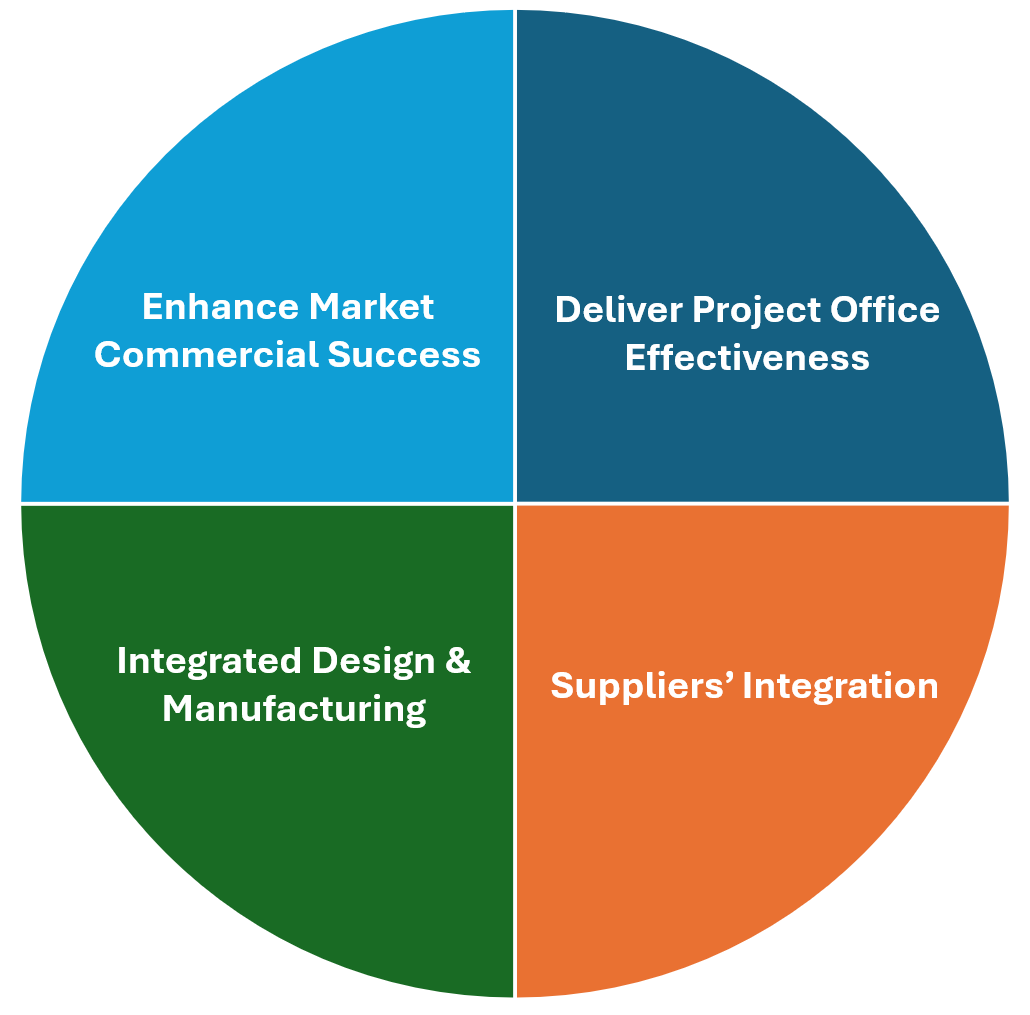
What is OPINEX?
OPINEX is a method of anchoring integrated operational and innovation excellence skills and practices in an organisation through a structured and tailored capability development Program.
OPINEX Program is a tailored flow of training modules that can be delivered in a virtual and face-to-face-format, supported by implementation workshops where the participants have an opportunity to deliver tangible outcomes in developing new market solutions - new products with:
- improved functionality focused on fulfilling validated customer needs
- lower total product cost (material, manufacturing overhead, warranty)
- higher quality due to increased simplicity of the design and manufacturing process
- improved robustness in terms of manufacturing, assembly, transport and customer usage
- sharper market positioning
Th client should consider OPINEX if they are planning to renew existing product line (sharpen market position and market share, reduce operational costs – increase profitability, improve customer satisfaction levels) or improve any other related aspect of the business.
OPINEX outcomes can be measured by using the following established operational & financial KPIs:
- Reduced Warranty (reduced PPM) - fewer claims & associated costs
- Improved OEE and FTT for the product line
- Reduced Scrap Rate and reduced Cost of Poor Quality for the product line
- Costed BOM on target to ensure the required profit margin
- Faster TTM (Time to Market) – accelerated development
- Higher Market Share than for the current product
- Higher Profit Margin
The following training & implementation options are available:
- Individual training module: virtual or face-to-face
- Individual training module: virtual or face-to-face, plus implementation workshop
- Training only bundle: training modules virtual or face-to-face
- Training + implementation bundle: training modules virtual or face-to-face plus implementation workshops
- OPINEX Program (all bundles): can be tailored to exact client needs; this requires scoping discussion (free of charge) ahead of any commitment
OPINEX Program Courses and Bundles
The following courses and course bundles are included:
- 1. Enhance Market Commercial Success (EMCS) Bundle:
- 2. Deliver Project Office Success (POS) Bundle:
- 3. Integrated Design & Manufacturing (IDM) Bundle:
- 4. Suppliers’ Integration (SI) Bundle:
All training offerings are:
- Generic – applicable and adaptable to any industry sector
- Scalable - depending on the client requirements and depth of knowledge required
- Flexible - any training course can be delivered as a standalone, or combined with other training courses from the same bundle to form a “hybrid” training offer
Delivery methods are:
- Virtual: for maximum 15 participants per training cohort
- Face-to-face: for maximum of 25 participants per cohort
- Implementation workshops: practical demonstration of skills on a real client case/project

OPINEX Program can be used to improve the performance output of existing as well as of new product lines. It supports innovative out of box thinking & decision-making in all segments of the customer value chain, from suppliers to the end customer.
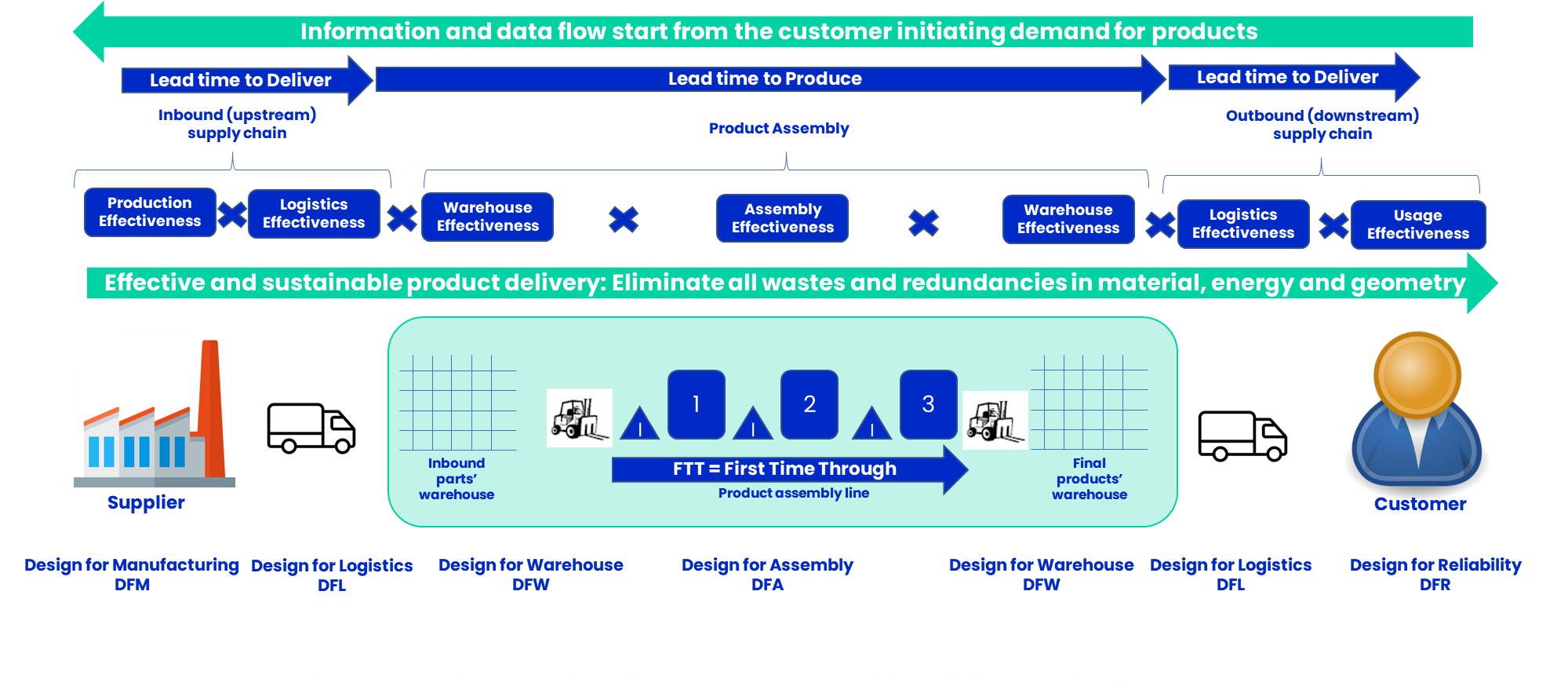
The aim is to deliver the Return on Investment ROI of at least 5 as a result of adopting and executing OPINEX Program in the client organisation. The actual ROI is far greater due to long-lasting transfer of knowledge to the entire organisation.
OPINEX Program Description
The Program was developed based on various lessons learnt, established industry practices and benchmarks from a variety of industries and represent a fairly unique value-adding service to any manufacturing business. It is based on 30 years’ of experience in the manufacturing sector globally.
The Program can be assumed as a vitally important and necessary first step, which allows team & capability building, increases feasibility and predictability of the targeted outcome, secures support & funding and creates a performance focused organisation ready to take the initiative. The OPINEX coincides with an initial feasibility phase of any Strategic Initiative in the client organisation. OPINEX supports organisational efforts to improve the product line performance in any phase of the product life cycle (PLM), from initial development and market introduction to the end-of-life.
The Program is designed in a highly modular fashion and allows a high degree of flexibility in tailoring to its most optimal version for each client interested in improving its operational and innovative capabilities and performance. OPINEX serves as a foundation for the following:
- Development of all-new generation of products (product lines)
- Development of on-going product improvements (cost reduction, quality improvements)
- Development of product extensions (improved sub-versions of existing products)
- Major product line cost down activities
- Improvement of customer satisfaction (warranty cost and customer success metrics)
- Improvements in the souring strategy relative to innovation capability of suppliers
The following are the key steps (A – F) of OPINEX Program if delivered in full capacity:
-
A. Deliver Project Office Success (POS)
- Pre-Program Preparation – assumes all activities in securing resources, mobilising relevant stakeholders, developing required organisational focus A. and collecting data and information to confirm the Program scope and define expected measurable targets
- Kick-off & Team Building – marks the formal start of the Program and allows the team bonding with the Sponsors and development of the formal commitment to deliver
- Initial Program Plan & Governance - initial collaborative skeleton planning of the Program activities and the development of the reporting, progress monitoring and documentation structure
-
B. Enhance Market Commercial Success (EMCS)
- Set Market Launch Targets – scoping and quantification of measurable targets for the product market launch based on previous market intelligence, competitive benchmarking etc.
- Lean Voice of Customer (LVOC) & Initial Customer Involvement – gathering relevant resources with the product and market knowledge to determine the initial draft of the Customer Requirements Specification and design engagement with selected customers to verify that knowledge. Requires strong facilitation which is provided as part of the Program support.
-
C. Integrated Design & Manufacturing (IDM)
- SFMEA – develop a “system” view on the key functions and failures of the product in question in the customer eyes. The system (environment where the product is being manufactured, transported and operated) is represented by all elements of the value chain including own assembly, packaging and transport and inclusive of the customer environment
- Design to Cost (DTC) – is a foundation for setting the correct cost target for the new product based on clarifying the cost structure of an existing product. The cost drivers are to be clearly understood at this stage, and sensitivity to various design and manufacturing parameters. This activity serves as an opportunity to develop a focused cost-down pilot which will drive subsequent design decisions at a later stage
- DFMEA – is a logical continuation of the SFMEA, looking at the product structure (modules and components) and design (geometry and materials), key functions and its sub-functions, and failures that are associated with (sub)functions. DFMEA serves as a form of a design review and challenge for the current product design from a failure – risk – customer impact perspective
- 3P + PFMEA+DFM/A+DFS+DFLT – is the focal point of the entire Program and by far the most complex and value-adding decision-making mind-shaping activity. This is the opportunity to shape the new product design, its supply chain and the manufacturing (final assembly) integrated concept solution. This is the true cross-functional and facilitation driven event where Design for Manufacturability & Assembly (DFM/A), Design for Logistics and Transport (DFLT) and Design for Service (DFS) best practices and compromises are synergised together to develop a comprehensive value chain solution from suppliers to the final customer – buyer of the product. This activity allows the team to see it all together for the first time based on the joined effort
-
D. Suppliers’ Integration (SI)
- Sourcing Strategy and Integration of Suppliers – enables analysis of the supply chain readiness to support the Program. It also creates a capability evaluation of each supplier from various technical and commercial perspectives. Ultimately, the team will be encouraged to define the best way to engage with suppliers early into the Program execution and to minimize risks of late or incomplete involvement
-
E. Enhance Market Commercial Success (EMCS)
- Market Launch Planning – refines and details the Market Launch Targets and how they will be realised. With the benefit of knowing the entire value chain concept solution, it allows development of launch plans, setting up of the launch team and integrating launch preparation into the Program Master plan. It also allows the Program team to clearly define the differentiating market positioning strategy enabling sales and the market share
-
F. Deliver Project Office Success (POS)
- Detailed Go to Market Planning and Start of the Project Engine – is the final activity before being ready to execute the plan. This is about creating a collaborative (team) plan of attack and winning the Sponsors’ final “Go ahead” approval
Investment Options
Below is the indicative investment overview for each training course being delivered on its own (table 1). It is based on assumed number of days (can be virtual or F2F) plus an optional practical implementation workshop which is always face-to-face (at the client’s site or elsewhere).
Each training course is scalable, and therefore the pricing can be adjusted accordingly. Optional implementation workshop is included in the price just to give a holistic view on the investment.
Travel expenses to the client’s site (transport, hotel & food) will be added to the course delivery investment.
| Course Number | Bundle | Course Code | Training [days] | Workshop [days] | Total [days] | Investment [EUR] |
|---|---|---|---|---|---|---|
| 1.1 | EMCS | LVOC | 2 | 2 | 4 | tbd |
| 1.2 | EMCS | CISJ | 1 | 2 | 3 | tbd |
| 1.3 | EMCS | NPML | 2 | 2 | 4 | tbd |
| 2.1 | POS | PPME | 3 | 2 | 5 | tbd |
| 3.1 | IDM | DFM/A | 3 | 3 | tbd | |
| 3.2 | IDM | DFS | 2 | 2 | tbd | |
| 3.3 | IDM | DTC | 2 | 2 | 4 | tbd |
| 3.4 | IDM | DFLT | 1 | 1 | tbd | |
| 3.5 | IDM | 3P | 2 | 5 | 7 | tbd |
| 3.6 | IDM | FMEA | 2 | 3 | 5 | tbd |
| 4.1 | SI | SSSIIP | 2 | 2 | 4 | tbd |
| Total | 22 | 20 | 42 | tbd |
Table 1: Summary of individual courses
| Course Number | Bundle | Training [days] | Workshop [days] | Total [days] | Investment [EUR] | Discount 10% [EUR] |
|---|---|---|---|---|---|---|
| 1 | EMCS | 5 | 6 | 11 | tbd | tbd |
| 2 | POS | 3 | 2 | 5 | tbd | tbd |
| 3 | IDM | 12 | 6 | 20 | tbd | tbd |
| 4 | SI | 2 | 2 | 4 | tbd | tbd |
| Total | 22 | 20 | 42 | tbd | tbd |
Table 2: Summary of the course bundles & for the entire Program
It is possible to qualify for a discount of 10% by taking an entire bundle (training + implementation) – see table 2 for reduced indicative investment.
Should a client wish to opt for the entire OPINEX Program (all 4 bundles: training + implementation clustered together), the total indicative investment will be discussed with the client. An accurate investment amount will be confirmed upon completed Program Scoping Consultation (free of charge). During the consultation, the client will be given several Program scenarios to compare to each other and choose the one that best fits its requirements.
For larger training teams (>25 people) it is possible to further adjust the investment amount per each training cohort.
General Prerequisites for OPINEX Program (Training & Implementation)
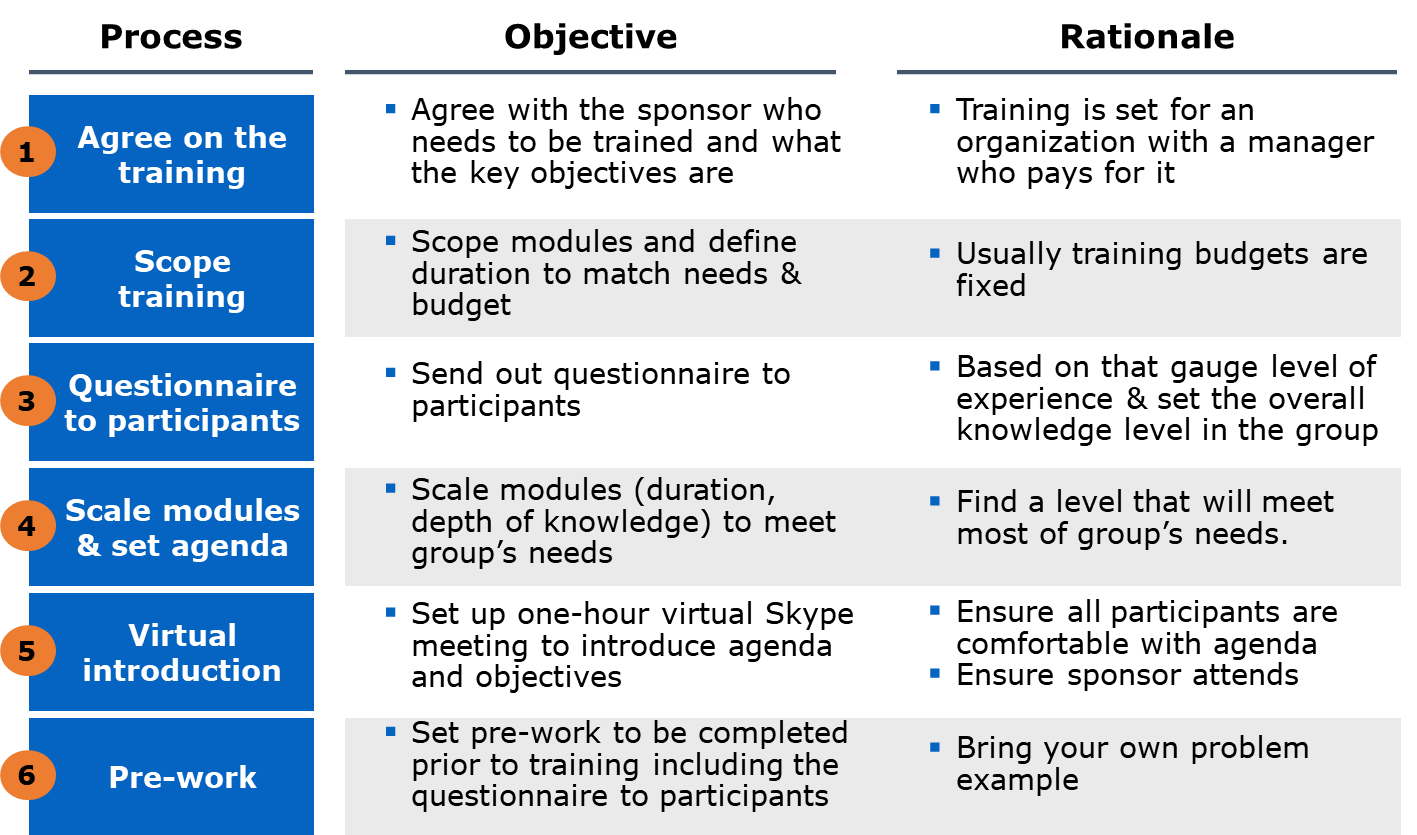
Prior to the start of the Program, the trainer will:
- clarify the organisational desire/need for the training, which ensures correct positioning of the training in the client organisation and with a clear objective.
- confirm who the key decision-maker/buyer (sponsor) of the training is, and make sure it is clear what his/her expectations are?
- calibrate expectations, as a mutual trust-building process with the decision-maker, and also align with the rest of the client’s organisation
- adjust the training content, materials, duration and delivery style and align with the client’s decision-maker(s) based on business needs
- issue an on-line survey to understand prior knowledge of trainees will give important feedback to the trainer prior to the training delivery start date
- organise a virtual meeting, typically one week ahead of the first training session, to get all participants and the sponsor together and to ensure a head-start of the training with aligned expectations and objectives
Prior to the start of the Program the client representative will:
- explain and document their business environment: products, customers, suppliers, manufacturing technologies & practices, design challenges, x-functional team working practices, NPD framework, quality standard, operational KPIs etc.
- book a large enough training room with usual presentation facilities, large free wall spaces, natural ventilation and lighting, if at all possible, plus a few break-out rooms. Ideally close to the production facility so an easy “Gemba” visit is possible (only for in-person delivery)
- ensure all trainees’ calendars are up to date and that the training is scheduled
Target Audience
The OPINEX training & implementation Program is targeted at the following functions within the client organisation, however the list is not finite and limited to functions listed below:
- Program/Project Office
- R&D
- Product Management
- Procurement (Strategic and Factory)
- Internal Manufacturing Quality Assurance
- Supplier Quality Assistance
- Customer Service
- Sales
- Production Technology
- Production Planning
- Factory Equipment Maintenance
- Suppliers
About the Lead Program Trainer & Author of OPINEX
Milos is a well-trained Professional (Chartered) Mechanical Engineer from the UK with a very strong academic background (MSc in Advanced Mechanical Engineering with a First-Class Honours pass) from Imperial College in London, UK, which is one of the most distinguished academic institutions globally with a strong engineering pedigree. Milos studied for his undergraduate degree in Serbia, Belgrade, where he focused his studies on Production Engineering, Industrial Robotics & Automation.
Milos was professionally certified as: a Lean/Six Sigma Green/Black Belt practitioner from the Automotive & Logistics services industries, trained and certified Lean Product Development and Lean Manufacturing Consultant in Danfoss. Milos was also trained to PMP standards for Project Management competencies, completed Ford’s Technical Excellence Academy covering practical application of various manufacturing technologies and quality management tools (APQP toolbox). Milos was a Lead Trainer at Danfoss Business System Academy, specialising in Leadership in New Product Development and Lean Manufacturing courses’ delivery to 300+ participants globally.
Milos mastered Product Development Stage Gate & Hybrid Agile Frameworks by working in the Automotive, Logistics, and many other industries. As a Senior Consultant for Product Development Program in Danfoss, Milos was serving the global manufacturing & supply chain footprint by introducing best practices in New Product Development and New Product Market Introduction. During that period Milos mastered the delivery of the 3P workshop (Product and Process Preparation), a modified version of an original Toyota tool. 3P is a vehicle for the adoption of Design for “XX” (Manufacturability and Assembly, Logistics & Transport, and Service) during the product concept development. Milos adopted the best approach to scale and tailor this workshop to the needs of various cross-functional product development teams, helping them to eliminate expensive and late design changes by making the right and timely decisions with predictable impact on the manufacturing and on the supply chain. Milos was also known as a senior technical leader and subject matter expert for the adoption of FMEAs and other quality tools in New Product Development & Manufacturing.
Milos is known for his Gemba (“Go and see”) style of working within the manufacturing environment, as he insists on practical solutions rather than on just academic discussions. This being the underlying principle for the adoption of the OPINEX Program.
Milos was partnered with a distinguished Danish consultancy, Valcon, where he supported efforts with large-scale global manufacturing clients to adopt a very advanced design methodology called the “Robust Design.” While “Robust Design” is solely the intellectual property of Valcon, Milos will explain the fundamentals of the “Robust Design” and how it directly complements the DFM/A principles during the OPINEX Program. “Robust Design” is about designing out the need for tight tolerances by the elimination of geometrical over-constraints. By adopting this practical design skill, it is possible to eliminate significant costs from the entire supply chain – practicalities will be explained during the training.
Milos was an associate of a California-based NPD consultancy – DRM Associates, and he was delivering numerous training workshops relating to NPD and Lean Manufacturing excellence to the US-based large corporate clients.
During his career, Milos had a truly global experience working on all continents and cooperating with a variety of manufacturers, toolmakers, designers, consultants etc, which gave him a unique blend of consolidated industry-wide case-studies, and the authority of a technical expert in this field. Milos can effectively transfer the knowledge to any new client/industry through analogies and similarities and based on his prior experience.
Milos is a very entrepreneurial person, loves action and results, is a simple yet effective and approachable communicator and trainer. He can coach, train, inspire, problem-solve, lead projects and initiatives, and make an instant change in any organization.
Throughout his career, Milos achieved significant results, such as supporting clients in reducing new product development cycles, improving product quality and serviceability, cutting tooling lead times, and transforming team cultures. Some case study examples can be found on: www.simmtex.com
Please enquire at milos@simmtex.com or call +44 7867 900 214 to get more information.