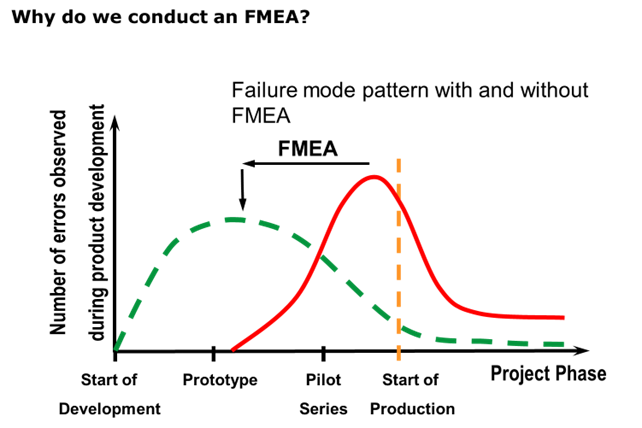
Failure Mode and Effects Analysis (FMEA) is a method of identifying and understanding potential failure modes, their causes, and their effects on a system or end users. It is an engineering analysis done by a cross-functional team of subject matter experts that thoroughly analyses product designs or manufacturing processes early in the product development process. The primary objective of an FMEA is to improve the design, whether it is for a system, subsystem, component, or manufacturing process. It serves as a guide for developing actions to reduce risk.
There are three essential FMEA types:
- System - Highest-level analysis focusing on system-related deficiencies, system safety, integration, and interfaces. Looking at the product and its key functions delivered to the customer, and how they can. Strongly associated with all steps in the product value chain (manufacturing, assembly, transport) to the final customer
- Design – Analysis at the subsystem or component level, focusing on product design-related deficiencies, improving the design, and ensuring safe and reliable product operation. Looking at the design of the product with its constituent components and how the product functions are delivered. Failure modes can occur on any sub-function related to the particular component(s). Strongly associated with the product design architecture.
- Process – Focusing on manufacturing-related deficiencies and ensuring the product is built to design requirements. Analyse how manufacturing functions (value-add assembly steps) are delivered and if they can cause product failure. Strongly associated with the manufacturing process design.
Duration
The training lasts two days in its fully blown format that allows sufficient time for the course content to be absorbed and processed by the participants. However, it is possible to scale down the training to 1 day, subject to agreement at the initial consultation. The real application of FMEAs becomes part of the preparation and execution of the 3P workshop, where participants can synergise their knowledge of FMEA types in the development of an integrated product and manufacturing process design.
Who is it for?
- Project/Program Manager
- Product Management
- Procurement (Strategic and Factory)
- Internal Manufacturing Quality Assurance
- Supplier Quality Assistance
- Sales
- Production Technology
- Factory Equipment Maintenance
- Suppliers (optional)
Content
Overall Focus: This training provides a structured approach for facilitating FMEA workshops, particularly in the context of product FMEA. It emphasizes the importance of considering both functional and non-functional requirements throughout the value chain, and promotes a robust, team-oriented approach to identifying and mitigating potential failures.
1. Introduction to Product FMEA:
- Explains why product FMEA is essential, focusing on how products can fail within customer applications and key modules.
- Highlights the significance of SFMEA (System FMEA) and DFMEA (Design FMEA) parts.
- Discusses FMEA timing within the product development lifecycle (M0-M1 & M1-M5) and the FMEA process in the M0-M1 calendar.
2. Preparation for FMEA Workshops:
- Emphasizes team selection, mindset, and preparation (starting 2-3 weeks before the workshop).
- Discusses scaling drivers and the appropriate scope for FMEA.
- Mentions the use of templates and necessary materials.
3. Execution of FMEA Workshops:
- A stepwise process to define and review the following:
- Boundary diagram.
- Value chain steps.
- Personas and applications.
- Relevant documents.
- Product architecture and BOM.
- Functional tree.
- Components vs. functions matrix.
- P diagram.
- Guidance on how to review and fill out the FMEA template.
4. Tools and Techniques:
- Boundary Diagram:
- Identifies interfaces and relationships with neighbouring systems.
- Provides a clear graphical representation of the system.
- Personas:
- Define user profiles to better understand requirements and potential use scenarios.
- Link personas to value chain steps to identify specific requirements.
- Value Chain:
- Defines steps from the factory to product installation and use.
- Identifies functional and non-functional requirements for each step.
- Product Architecture (3P Workshop):
- Functional understanding is derived from the 3P workshop.
- Defines how product architecture allows the build-up of functions per module.
- Criticality Matrix:
- Guides sourcing strategy by identifying components critical to product performance and commercial success.
- P Diagram:
- A tool for analysing inputs, outputs, control factors, noise factors, and error states.
- Components vs. Functions Matrix:
- Defines the relationship between product components and their functions.
- Aids in identifying potential failure modes.
- FMEA Template:
- Step-by-step instructions on how to fill out the template.
5. Facilitator's Tips and Best Practices:
- Structuring the FMEA workshop for efficiency.
- Using posters and visual aids.
- Engaging the team effectively in filling out the FMEA template.
- Analysing and interpreting the FMEA results to drive action.
- Considering the "Cost down engine" pyramid to optimize the FMEA process.
Delivery Options
- Initial consultation: virtual 2-hour meeting (free of charge)
- Virtual delivery of training modules (4 half-day sessions)
- Physical on-site training delivery over 2 full days is a possibility
-
Agile, iterative & practical (on-site) facilitation and support in developing & implementing
FMEAs (System, Design and Process) in a real project.
- This can be done as a standalone effort and can take up to three on-site days.
- The other option is to execute SFMEA and DFMEA as part of building knowledge and preparing for the 3P workshop; thereafter, integrate PFMEA as part of 3P workshop
Objectives
- Equip FMEA facilitators with the knowledge and tools needed to conduct effective FMEA workshops, resulting in more robust products and processes. This training also develops strong facilitation skills required to get through FMEA projects, so the client is encouraged to delegate someone who is keen on progressing to that role.
- Identifying and preventing safety hazards – FMEA allows consolidation of the organisational knowledge in that respect, leading to the development of preventive SOPs for manufacturing equipment in factories, but also Design guidelines for product safety.
- Minimizing loss of product performance by understanding manufacturing failure modes, and what can cause them. Prevention can build into the manufacturing process design during the 3P workshop, when PFMEA will be reviewed and preventive action will be identified.
- Improving test and verification plans by increasing the detectability of failures early
- Improving Process Control Plans that will focus on the elimination of known root causes
- Considering changes to product design or manufacturing processes, noting that FMEA also serves as a tool for design review.
- Identifying significant product or process characteristics as the correlation between product features and manufacturing failures, will become obvious
- Generating organisational product knowledge and documenting it in a structured way – can be used as a basis for product training for young engineers
Outcomes
- FMEA (System, Design and Process) updated with the benefit of team’s effort.
- Based on RPN level, prioritised actions
-
Documented knowledge about product functions, failure modes, root causes, and
impact on the customer - Preventive actions will reduce the development lead time and minimise the need for late and expensive product changes, causing delays and poor product launches