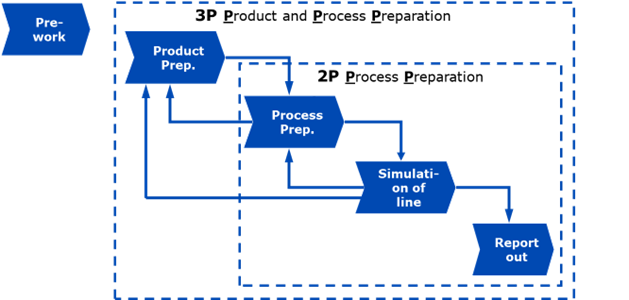
The Product & Process Preparation builds upon lean manufacturing and lean product development principles by using a cross-functional team to define an optimal product concept and an optimal production/assembly process that ensures delivery of the newly developed product to the market in a timely and cost/quality effective way. The 3P workshop intends to link the product design with the manufacturing (assembly) process design, creating a solution that is both valuable to the customer and cost-effective to produce.
The power of this workshop relies on a hands-on approach to defining and evaluating both product and production process alternatives and evaluating them from the perspective of design for manufacturability, mistake-proofing, and lean manufacturing practices. 3P is the best way to integrate DFM/A, DFS, DTCT & DFLT in the most practical way.
Duration
The basic training is a two-day event. This training emulates the real workshop environment and motivates participants to be as creative and as proactive as possible by using a simple process example that is worked through almost as if it were an actual event. The learning style is based on 75% learning by doing and 25% through presentation and discussion. An extended three-to-five-day version is focused on working with a team to apply 3P to an actual project as part of the OPINEX Program.
Who is it for?
- Project/Program Manager
- Product Management
- Procurement (Strategic and Factory)
- Internal Manufacturing Quality Assurance
- Supplier Quality Assistance
- Sales
- Production Technology
- Factory Equipment Maintenance
- Suppliers (optional)
Content
Day 1: Preparation and Scoping of 3P
Introduction
- Define the 3P workshop concept and its purpose
- Define the team’s mindset and approach to the 3P workshop
- Position 3P workshop relative to NPD project maturity
- 3P workshop flow and the key elements described
- Define key inputs, team preparation, and prerequisites for the workshop
- Define key outputs and benefits of the workshop and how this drives subsequent product development efforts
Define an example product, market, and supply chain
- The team is given a “fact pack” of information as an introduction to the chosen product example
- Team will align around project facts and what they mean for product/assembly concepts development
- Team exercise: how to collect information, prepare, and scale the effort for a real 3P workshop
Day 2: Product Concept Development
- Review of the key principles behind the design for manufacturing/assembly (DFM/A) concept
- Review how to define product functions
- Team exercise: Define functions for the chosen example product
- Introduce the minimum part count concept aimed at reducing the number of parts in an assembly
- Team exercise: define minimum number of parts for the chosen example product
- Brainstorm design alternatives for chosen product functions – “7 Ways or 7 Alternatives” method
- Team exercise: Brainstorm design alternatives for the chosen example product
- Explain the concept selection matrix for evaluating concepts
- Team exercise: Select the best product concept using the concept selection matrix
- Review the final product concept – hand out examples of a physical product
Day 3: Manufacturing Process Development
- Review lean manufacturing principles
- Introduce Process at a Glance (PAAG) method for “as is” manufacturing process summary
- Team exercise: Conduct manufacturing process review for the chosen example product and develop Process at a Glance (PAAG) map.
- Team brainstorming: Define scope for simulation
- Team exercise: Define process alternatives (“7 Ways or 7 Alternatives”) for the given scope
- Team exercise: Define an optimal assembly process based on best alternatives – use concept selection matrix to drive decision
- Team exercise: Build a prototype simulation manufacturing cell using cardboard boxes and any other means.
- Conduct Gemba visit to a real production line if nearby for inspiration (or watch a video of the current production)
- Use “real-world” packaging, tools, or any other equipment from the real production line if available
Day 4 & 5: Manufacturing Process Simulation & Reporting
- Team exercise: Simulate & video record manufacturing process and capture improvements by watching each production run – repeat until the team is happy.
- Set targets for productivity (cycle time, takt time, minimum number of operators) based on the business case and verify how they can be achieved – team discussion after each simulation run
- Define required investments in automation and other process equipment (jigs, fixtures, measurement systems etc.) based on requirements – consider how product design is influencing the manufacturing process design and vice versa
- Pay attention to line balancing and how those influences inventory levels, number of operators online, takt time etc.
- Capture key manufacturing functions that lead to development of the PFMEA
- Discuss team’s “learning by doing” approach and what benefits it brings to early decision making and team alignment
- Wrap up: Key learnings and conclusions arising from product and production concepts development
- Team exercise: Draft summary report from 3P workshop
Delivery options
- Initial consultation: virtual 2-hour meeting (free of charge)
- Virtual delivery of training modules (4 half-day sessions)
- Physical on-site training delivery over 2 full days is a possibility
- Agile, iterative & practical (on-site) facilitation and support in developing & implementing 3P in a real project by merging the effort of preparation and execution of the 3P workshop in one longer assignment. Memo: This scenario typically requires 1-2 days of preparation for the 3P and a virtual 1-day training covering the basic 3P, followed by a 3-5-day 3P workshop (at the client and/or supplier’s manufacturing site). The duration depends on the product complexity.
Objectives
- Define an Optimal Product Concept: Determine the best design for a new or improved product that meets market needs and aligns with the overall business case.
- Optimize Production/Assembly Process: Develop the most efficient and effective methods for manufacturing and assembling the product, considering design for manufacturability, mistake-proofing, and lean manufacturing principles.
- Maximise efficiency: Setting targets for productivity (cycle time, minimum number of operators) with an understanding whether it can be achieved
- Use a learning by doing approach to help with discussions between teams.
- Identify Required Investments: Determine the necessary investments in automation, tooling, fixtures, measurement systems, and other process equipment to support the optimized production process.
- Emulate a Real-World Environment: By emulating an actual workshop environment, the team will be motivated to be creative and proactive.
- Create a learning environment for the teams
Outcomes
- Optimized product design and production process concepts that complement each other
- Aligned cross-functional team with a common understanding of the product and manufacturing concepts
- Good estimates of the investment levels into manufacturing, lead times, and productivity
- PFMEA revised and updated based on 3P simulation and team inputs